EXAM READY ECONOMICS
How to Answer 4-Mark Questions in A-Level Economics (With Past Paper Examples)
Let's be honest: those 4-mark questions look easy. They're short, they're worth "only" 4 marks, and you think, "I'll just wing it."
Then results day comes, and you've dropped 2 marks here, 1 mark there... and suddenly those "easy" questions have cost you a whole grade.
Sound familiar?
Here's the good news: 4-markers have a formula. Learn it once, use it forever, and watch those marks roll in.
Whether you're doing AQA or Edexcel, this guide breaks down exactly how to structure your answer, what examiners are looking for, and how to avoid the most common mistakes that lose students easy marks.
Why 4-Mark Questions Matter More Than You Think
What Examiners Are Actually Looking For
The Perfect 4-Mark Structure
Step-by-Step Breakdown (With Real Examples)
Common Mistakes That Cost You Marks
Practice Questions & Model Answers
Here's something your teacher might not have told you: 4-mark questions are the easiest marks to secure in the entire exam.
Think about it:
No complex evaluation needed
No 500-word essays
Just clear definitions and extract application
4-6 minutes of work = 4 guaranteed marks
But here's the catch: most students lose marks because they don't follow the structure.
They write too much waffle, forget to quote the extract, or miss definitions entirely.
The reality: If you master 4-markers, you're already ahead of 60% of students in the exam hall.
In a Paper 1 with multiple 4-mark questions, that's the difference between a B and an A.
Every 4-mark question tests two Assessment Objectives:
AO1: Knowledge (2 marks)
This means: Can you define economic terms accurately?
Examiners want textbook-quality definitions—clear, precise, no waffle.
AO2: Application (2 marks)
This means: Can you apply those terms to the extract/data provided?
You need to reference figures, extract letters, or specific data from the source material.
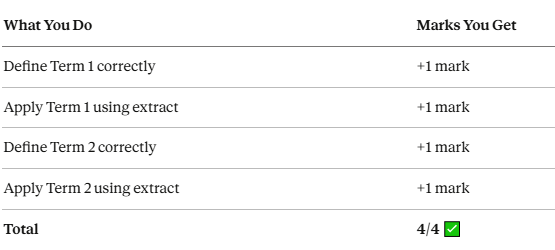
Pro tip: You literally cannot get full marks without both definitions AND extract references. Miss either, and you're capped at 2/4.
Here's the magic formula that works every single time:
K.A.K.A. Structure
K – Knowledge (Define Term 1)
A – Application (Apply Term 1 using extract)
K – Knowledge (Define Term 2)
A – Application (Apply Term 2 using extract)
Simple. Systematic. Guaranteed marks.
Why This Works:
✅ Covers both assessment objectives
✅ Forces you to quote the extract (easy application marks)
✅ Keeps you focused and concise
✅ Takes exactly 4-6 minutes
Let's see it in action with a real exam question...
📝 Edexcel Paper 1 (June 2023) Question 6(d):
"Using examples from the information provided, explain what is meant by both 'substitutes' and 'complementary goods'." (4 marks)
Extract A: When Netflix raised its subscription price in 2022, many consumers switched to alternatives like Amazon Prime and Disney+ for streamed television content.
Extract B: Sales of flatscreen televisions increased alongside the growth in streaming services, as consumers wanted better viewing experiences.
🧩 Step 1: Define the First Term (Knowledge – 1 mark)
Start with a clear, textbook-style definition. No fluff, no examples yet—just the pure definition.
Example:
"Substitute goods are products that can replace each other because they satisfy the same consumer need or want."
✅ Mark secured: 1/4
Top tip: If you can't remember the exact definition, think about the word itself—"substitute" means "swap" or "replace."
🧩 Step 2: Apply First Term Using the Extract (Application – 1 mark)
Now bring in the extract. Reference it explicitly using phrases like:
"According to Extract A..."
"As shown in Extract B..."
"The data in Figure 1 demonstrates..."
Example:
"According to Extract A, when Netflix raised its subscription price, some consumers switched to alternatives like Amazon Prime or Disney+, which are substitutes because they also provide streamed television content."
✅ Marks secured: 2/4
Why this works: You've directly quoted the extract AND explained how it relates to the definition.
🧩 Step 3: Define the Second Term (Knowledge – 1 mark)
Keep it short, accurate, and focused.
Example:
"Complementary goods are products that are consumed together, where the consumption of one increases the demand for the other."
✅ Marks secured: 3/4
Memory hack: Think "complete the pair"—like fish & chips, or phones & phone cases.
🧩 Step 4: Apply Second Term Using the Extract (Application – 1 mark)
Reference the extract again with specific examples or data.
Example:
"Extract B mentions that flatscreen televisions are often bought to enhance the experience of streamed television services, showing a complementary relationship between the two."
✅ Marks secured: 4/4 🎉
Full Model Answer:
Substitute goods are products that can replace each other because they satisfy the same consumer need or want. According to Extract A, when Netflix raised its subscription price, some consumers switched to alternatives like Amazon Prime or Disney+, which are substitutes because they also provide streamed television content.
Complementary goods are products that are consumed together, where the consumption of one increases the demand for the other. Extract B mentions that flatscreen televisions are often bought to enhance the experience of streamed television services, showing a complementary relationship between the two.
Mark breakdown:
✅ Knowledge: 2
✅ Application: 2
✅ Total: 4
❌ Mistake 1: Writing Too Much
Some students write paragraph after paragraph. You're marked on accuracy, not volume.
What students write:
"Substitute goods are really important in economics and they're used all the time by consumers who want to find alternatives to expensive products and they can be found in many different markets..."
What you should write:
"Substitute goods are products that can replace each other."
Mark difference: Both get 1 mark. One wastes 2 minutes. Don't be that student.
❌ Mistake 2: Not Quoting the Extract
Student answer:
"Substitutes are goods that replace each other, like Netflix and other streaming services."
Examiner's thought:
"Where's the extract reference? I can't give application marks."
Mark: 1/4 (only got the definition mark)
What you needed to say:
"According to Extract A, when Netflix raised prices, consumers switched to Amazon Prime and Disney+..."
Mark: 2/4 (definition + application)
❌ Mistake 3: Defining Only One Term
The question says "explain what is meant by both..."
If you only define substitutes and ignore complements? You've capped yourself at 2/4.
Always read the question twice. If it asks for two things, give two things.
❌ Mistake 4: Vague Extract References
Weak application:
"The extract shows that streaming services are substitutes."
Strong application:
"Extract A states that when Netflix raised prices in 2022, consumers switched to Amazon Prime and Disney+, demonstrating their role as substitute goods."
Difference: Specific reference to "Extract A" + actual data ("raised prices in 2022") = full application mark.
❌ Mistake 5: Forgetting Economic Terminology
Student answer: "These goods go together."
What examiners want: "Complementary goods are consumed together."
Use proper economic language—it shows you know your stuff.
1. Always Use K.A.K.A. Structure
Write it at the top of your answer space as a reminder:
K (define 1)
A (apply 1)
K (define 2)
A (apply 2)
This takes 10 seconds and guarantees you won't forget a section.
2. Reference the Extract Explicitly
Use these phrases religiously:
"According to Extract A..."
"As shown in Figure 1..."
"Extract B states that..."
"The data demonstrates..."
These signal to examiners: "I'm applying knowledge to the source—give me the mark!"
3. Time Management: 1 Mark Per Minute
4 marks = 4-5 minutes maximum.
If you're writing for 8 minutes, you're doing it wrong. Those extra minutes should go to your 15-mark or 25-mark essays where they actually matter.
4. Learn Core Definitions Cold
Make flashcards for:
Substitute goods
Complementary goods
Normal goods
Inferior goods
Public goods
Private goods
Externalities
Merit/demerit goods
These appear constantly in 4-markers. Know them backwards.
Theory is great. Practice is better.
Download past papers for both Edexcel & AQA website. Our Revision Tracker has all past papers too. Download it here
Do every 4-marker. Time yourself. Compare your answers to mark schemes.
Pro strategy: Our course library includes examiner-style 4-mark questions with model answers you can compare against because knowing what a top answer looks like is the fastest way to improve.
This week:
✅ Make definition flashcards for the top 20 economic terms
✅ Download 3 past papers and highlight all 4-mark questions
✅ Practice K.A.K.A. structure on 5 different questions
Before your next exam:
✅ Memorise key definitions word-for-word
✅ Practice referencing extracts naturally in your answers
✅ Time yourself—get your answers down to 4-5 minutes each
On exam day:
✅ Read the extract carefully and underline key data
✅ Write K.A.K.A. at the top of your answer space
✅ Check you've referenced the extract in BOTH applications
✅ Move on—don't overthink it!
🧠 Quick Recap: The 4-Mark Formula
✅ Structure: K.A.K.A. (Knowledge, Application, Knowledge, Application)
✅ Time: 4-5 minutes maximum
✅ Must include: Two definitions + two extract references
✅ Common trap: Forgetting to quote the extract
✅ Easy wins: Use "According to Extract A/B/Figure 1"
Why This Matters
Those 4-mark questions scattered throughout your exam? They're not filler—they're free marks if you know the formula.
Master this structure now, and you'll:
Save time in the exam (more for essays)
Boost your overall score consistently
Feel confident walking into the exam hall
Remember: Economics exams aren't about being naturally clever—they're about knowing the system and playing by the rules.
And 4-markers? They have the clearest rules of all.

Bubli -A Level Economics Tutor
I help my students stress less, score more, and enjoy Economics with real-life examples that click instantly.
Follow for more content updates
Free: The Revision Tracker 1000+ Students Are Using Right Now🡻
👉 including full-topic notes, model essays, essay structure, definition list, formula list, active recall quizzes, Essay Markings, and exclusive A* resources updated every week.
Click the button below to explore more and unlock the tools top students use to get ahead.

Bubli- A Level Economics Tutor
EXAM READY ECONOMICS
address: Kingfisher House, B3 Kingsway N, Gateshead NE11 0JQ
© 2025 ExamReadyEconomics