EXAM READY ECONOMICS
How to Answer a 15 Marker in Edexcel A Level Economics
Most students lose marks on 15 markers not because they don't understand the economics, but because they don't know how to structure an answer that matches what the examiner is looking for.
Here's the good news. Once you learn the structure, 15 markers become one of the most predictable question types on the paper. Let's break it down.
In Edexcel A Level Economics, a 15 mark question usually asks you to discuss, assess or evaluate an economic issue. It may also ask you to use information from an extract.
A 15 marker needs:
clear economic knowledge
developed chains of analysis
relevant application to the question or extract
strong evaluation
The key difference is this: a 15 marker does not need a separate final judgement in the same way a 25 mark essay does. However, it still needs strong evaluation throughout the answer.
That single difference changes how you should structure your response.
What structure should you use for a 15 marker?
A strong 15 mark answer should include:
Knowledge: Define or show clear understanding of the key economic concept in the question.
Application: Use the context from the question, extract, data or real-world example.
Analysis: Build a clear chain of reasoning that explains cause, effect and further effect.
Evaluation: Question the strength, likelihood or importance of your argument.
The easiest structure is:
KAA Point 1: Knowledge + application + analysis for your first point.
Evaluation 1: Evaluate your first argument.
KAA Point 2: Knowledge + application + analysis for your second point.
Evaluation 2: Evaluate your second argument.
In simple terms: Use: Define → Apply → Explain → Develop → Evaluate
Or: K → Ap → An → An → Eval
Example:
Knowledge: What is the key concept?
Application: What is the context?
Analysis: What happens first?
Further analysis: What happens next?
Evaluation: Why might this be limited?
This is the safest structure for most Edexcel 15 mark Economics questions.
If you are short on time, one very well-developed KAA point with strong evaluation can still score well. However, two KAA and evaluation pairs is the more reliable approach because it gives the examiner more to reward.
What does KAA mean in a 15 marker?
KAA stands for:
Knowledge
This means using accurate economic theory. For example, if the question is about a subsidy, you should show that you understand what a subsidy is and how it affects costs of production.
Application
This means linking your answer to the specific context. You might use the extract, figures, examples, the industry mentioned in the question, or the country in the case study.
Application should not feel like a random quote dropped into the paragraph. It should be used to support your point.
Weak application: The extract says government spending increased.
Stronger application: As stated in Extract A/B , If the government increases spending on infrastructure, such as transport projects, this could increase demand for construction firms and create jobs in that sector.
Analysis: This means explaining the chain of reasoning step by step.
For example: Government spending is an injection into the circular flow of income. This increases aggregate demand because government spending is a component of AD. Higher AD may encourage firms to increase output, which can increase real GDP and reduce unemployment.
That is a proper analysis chain because it explains how one effect leads to another.
What should application look like?
Application is one of the easiest marks to gain, but many students miss it because they write generic answers.
A generic answer could apply to any question.
An applied answer clearly belongs to the exact question being asked.
For example, if the question is about a government subsidy for renewable energy firms, do not just write:
A subsidy lowers costs of production for firms.
Write: A subsidy for renewable energy firms would lower their costs of production, making it cheaper for firms to produce solar panels, wind turbines or other green energy technologies.
That second version is better because it uses the actual context of the question.
Try to include application in both KAA paragraphs. This could come from:
the extract
data figures
the industry
the country
the type of firm
the group affected
a relevant real-world example
Application should be blended into the analysis, not bolted on at the end.
The biggest jump in marks comes from learning how to explain your point in stages.
Examiners want to see a clear chain of reasoning.
This means showing: cause → effect → further effect
A weak answer simply states the outcome.
For example: Government spending increases AD, which increases economic growth.
This is not enough for a high-level answer because the chain is too short.
A stronger answer would say:
An increase in government spending is an injection into the circular flow of income. This directly increases aggregate demand because government spending is one of the components of AD. As AD rises, firms may experience higher demand for goods and services, leading them to increase output. This can increase real GDP and reduce unemployment as firms require more workers to meet the higher level of demand.
You can then extend the chain further using the multiplier effect:
The initial increase in government spending may also create a positive multiplier effect. For example, if the government spends money on a new infrastructure project, construction workers and suppliers may receive higher incomes. If they spend part of this extra income in the wider economy, consumption may also rise, causing a further increase in aggregate demand. This means the final increase in real GDP may be greater than the original rise in government spending.
That is the difference between basic analysis and developed analysis.
The stronger version does not just say “AD rises”. It explains why AD rises, how that affects output and employment, and how the multiplier effect can strengthen the final impact.
Evaluation is where many students lose marks.
Evaluation does not mean writing “however” and then saying the opposite. Good evaluation questions the strength of your own argument.
Useful evaluation angles include:
Time lags : Will the effect take a long time to happen? Does that matter in this situation?
Magnitude: Is the impact likely to be large or small?
Elasticity: Does price elasticity of demand or supply affect how strong the outcome will be?
Opportunity cost: Could the money or resources have been used in a better way?
Different groups affected: Does the policy affect consumers, firms, workers or the government differently?
Depends on the context: Does the outcome depend on the state of the economy, the size of the intervention or the behaviour of firms and consumers?
For example, if your analysis says that a subsidy reduces firms’ costs, your evaluation could question whether firms will actually pass on the lower costs to consumers.
A strong evaluation point could say:
However, the effectiveness of the subsidy depends on whether firms pass on the lower costs in the form of lower prices. If firms have strong market power, they may choose to keep the subsidy as extra profit instead. This would limit the fall in prices for consumers and reduce the impact on demand.
This is much stronger than simply saying, “However, subsidies are expensive.”
Why? Because it directly evaluates the original argument.
Yes, diagrams can still help in a 15 marker.
A correctly labelled and relevant diagram can support your analysis and help you explain your point more clearly.
The two most common mistakes are:
drawing a diagram but never referring to it in the answer
drawing a diagram that is not fully labelled
If you use a diagram, make sure you explain it in your writing.
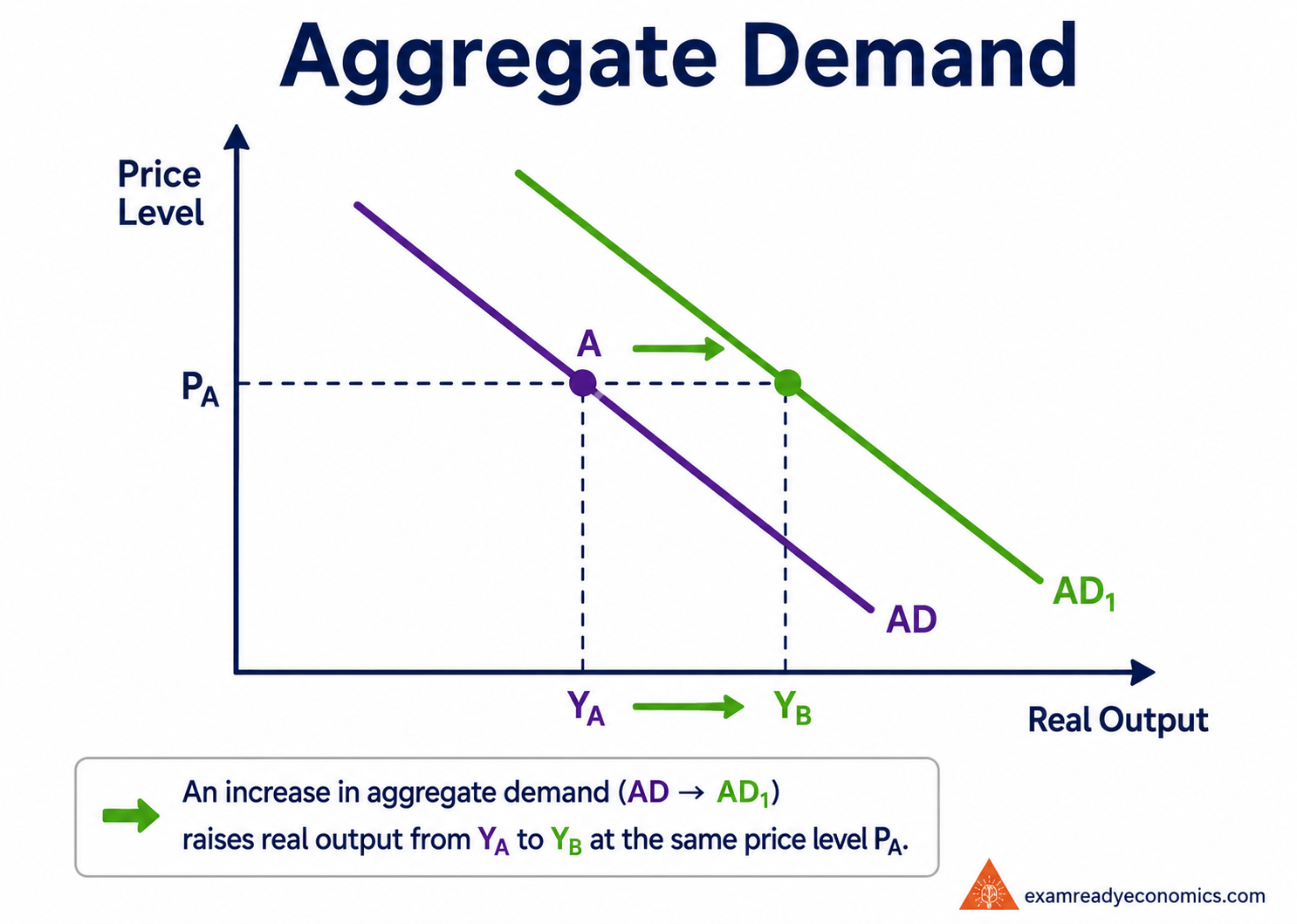
For example: The AD/AS diagram shows aggregate demand shifting from AD1 to AD2, leading to an increase in real GDP from Y1 to Y2. This supports the argument that higher government spending can increase economic growth in the short run.
Do not let the diagram just sit there looking pretty. It needs to work for its marks.
BONUS:
If the question says “with reference to the information provided” or is based on an extract, you should use the context in your answer.
This does not mean copying a long sentence from the extract.
Instead, use the extract to make your point more specific.
For example, you might refer to:
a figure or percentage
a named country
a particular market
a type of firm
a group of consumers
a problem mentioned in the extract
A strong answer uses the extract naturally inside the analysis.
For example:
If the extract shows that unemployment is rising, an increase in government spending may be more effective because there is likely to be spare capacity in the economy. This means firms can increase output without causing significant inflationary pressure.
That is much better than just writing, “The extract says unemployment is rising.”
You do not need a full final judgement in the same way you do for a 25 marker.
However, you can include a short final evaluative sentence if it helps your answer feel complete.
For example:
Overall, the impact of government spending on economic growth depends on the size of the multiplier and whether there is spare capacity in the economy.
That is enough. Do not spend too long writing a mini 25 marker conclusion. Your marks are better earned through strong analysis and evaluation throughout the answer.
Always read the command word carefully.
If the question says discuss, you need to explain the issue and consider its limitations.
If the question says assess, you need to decide how important, effective or significant something is.
If the question says evaluate, you need to analyse the argument and then question how strong it is.
The command word tells you what type of thinking the examiner wants. Do not just write everything you know about the topic. Shape your answer around the exact wording of the question
A good time target is around 15 to 18 minutes.
A simple time plan could look like this:
Spend 2 to 3 minutes planning your two main points.
Then write your first analysis and evaluation pair.
Then write your second analysis and evaluation pair.
Finally, leave around 1 minute to check that you have answered the exact question asked.
That final check matters. Many students write everything they know about a topic, but forget to stay focused on the wording of the question
writing only one-sided analysis with no evaluation
using “however” but not actually evaluating
copying the extract instead of applying it
drawing a diagram but not explaining it
writing a 25-marker style conclusion and running out of time
making two undeveloped points instead of one or two strong chains
forgetting to answer the exact wording of the question
The fastest way to improve is to practise past paper questions.
Not because the exact same questions repeat, but because the same core topics appear again and again in slightly different ways.
Common 15 marker topics include:
government intervention
market failure
externalities
economic growth
inflation
unemployment
trade
exchange rates
supply-side policies
The more past questions you practice, the faster you will recognise which analysis and evaluation points to use.
That is when 15 markers stop feeling scary and start feeling predictable.
If you are struggling to turn your Economics knowledge into high-mark essays, our Momentum membership is built to help A Level Economics students improve essay structure, evaluation and exam technique.
You will learn how to plan answers, build stronger chains of analysis and write evaluation that actually earns marks.
For students who need more personalised support, we also offer limited 1-1 tuition for Edexcel and AQA A Level Economics.

Bubli -A Level Economics Tutor
I help my students stress less, score more, and enjoy Economics with real-life examples that click instantly.
Follow for more content updates
Free: The Revision Tracker 1000+ Students Are Using Right Now🡻
👉 includes full-topic notes, new model essays added every week, essay structure, definition list, formula list, Essay structures, annotated essays and exclusive A* resources added every week.
Click the button below to explore more and unlock the tools top students use to get ahead.

Bubli- A Level Economics Tutor
EXAM READY ECONOMICS
address: Kingfisher House, B3 Kingsway N, Gateshead NE11 0JQ
© 2025 ExamReadyEconomics