EXAM READY ECONOMICS
Edexcel A-Level Economics A: Specification Explained
Just started Year 12 Economics? Welcome to one of the most interesting (and yes, sometimes challenging) A-Levels you'll take.
Here's what nobody tells you on day one: Economics isn't about memorising facts—it's about understanding how the world actually works.
Why did your favorite chocolate bar get smaller? How does the government decide interest rates? What makes some countries rich and others poor? You're about to find out.
But first, you need a map. The Edexcel specification is that map. It shows you exactly what you'll learn over the next two years and how you'll be tested on it.
This guide breaks it down in plain English so you can:
See the bigger picture before diving into details
Know what examiners actually want from day one
Study smarter, not harder throughout Year 12 and 13
Think of this as your friendly introduction to A-Level Economics. Let's get started.
Why the Specification Matters
The Four Economics Themes Explained
Assessment Structure & Exam Papers
How Examiners Mark Your Work
Top Revision Strategies
The specification isn't just a syllabus—it's your strategic roadmap to exam success. Here's what it reveals:
Exact topics examiners can test (no surprises on exam day)
Mark allocation across microeconomics and macroeconomics
Assessment objectives that determine how you're graded
Skill requirements beyond memorization
Pro tip: Students who understand the specification strategically score 15-20% higher on average than those who don't.
The course builds progressively from Year 12 foundations to advanced Year 13 analysis. Here's everything you need to know:
Core Concepts:
Economic fundamentals: scarcity, choice, and opportunity cost
Market mechanics: demand, supply, and price elasticity
Market failure causes: externalities, public goods, information asymmetry
Government intervention: taxation, subsidies, regulation, and price controls
Exam Success Strategy:
Master diagram drawing—negative externalities, subsidy effects, and price cap analysis appear in 80% of Theme 1 questions. Practice sketching these from memory weekly.
Real-world application: UK sugar tax (2018), plastic bag charges, congestion charging in London
Core Concepts:
Economic indicators: GDP growth, inflation (CPI), unemployment rates, balance of payments
Aggregate demand and supply: shifts, shocks, and the multiplier effect
Economic cycles: boom, recession, output gaps
Policy instruments: fiscal policy, monetary policy, supply-side reforms
Exam Success Strategy:
Always incorporate current UK economic data. Examiners specifically look for up-to-date context—reference recent Bank of England interest rate decisions, ONS inflation figures, or fiscal policy announcements.
Example statistics to memorize (update regularly):
UK inflation rate
Bank of England base rate
Unemployment rate
GDP growth rate
Core Concepts:
Business growth strategies: organic expansion vs mergers/demergers
Objectives: profit maximization, revenue maximization, satisficing behaviour
Cost-revenue analysis: TC, TR, AC, MC, AR, MR diagrams
Market structures: perfect competition, monopolistic competition, oligopoly, monopoly, contestability
Labour markets: wage determination, trade union impact, minimum wage effects, government intervention
Exam Success Strategy:
Use contemporary business examples. Mentioning Amazon's market dominance, Tesla's pricing strategy, or UK supermarket oligopolies (Tesco, Sainsbury's, Asda, Morrisons) earns valuable application marks.
Key diagrams to master:
Profit maximization (MC = MR)
Perfect competition vs monopoly
Labour market equilibrium
Minimum wage effects
Core Concepts:
Globalization dynamics and international trade theory
WTO, free trade agreements, and protectionism (tariffs, quotas, subsidies)
Exchange rates, terms of trade, and international competitiveness
Development economics: poverty, inequality (Gini coefficient, Lorenz curve)
Emerging economies: development strategies and challenges
Financial sector: banking, central banks, financial regulation
Public finance: taxation systems, government spending, national debt
Exam Success Strategy:
Build a case study library. Strong answers reference China's Belt and Road Initiative, post-Brexit UK trade deals, IMF structural adjustment programmes or developing economy success stories like Vietnam and Rwanda.
Hot topics for 2025:
Global supply chain disruptions
Climate change and carbon taxation
Digital currencies and FinTech
Cost of living crisis
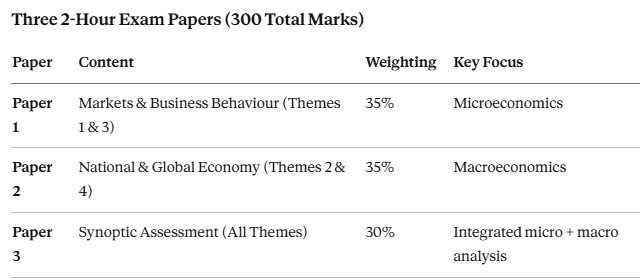
This is where A* candidates shine. You must:
Integrate microeconomic and macroeconomic concepts
Link theoretical frameworks across all four themes
Demonstrate sophisticated economic thinking
Apply multiple analytical perspectives to complex scenarios
Example synoptic question: "Evaluate whether government intervention in labour markets improves overall economic performance while considering impact on business competitiveness in global markets."
Understanding Assessment Objectives (AOs) is crucial—they determine how your answer is scored:
AO1: Knowledge & Understanding (22-24%)
Define economic terms accurately
Demonstrate theoretical understanding
Explain economic concepts clearly
Example: "Monopoly power exists when a single firm dominates a market with high barriers to entry, giving it price-setting ability."
AO2: Application (22-24%)
Reference data from extracts/case studies
Use real-world examples
Apply theory to specific contexts
Example: "The UK's £12.70 National Living Wage (2024) demonstrates government intervention in labour markets..."
AO3: Analysis (26-28%)
Build logical reasoning chains
Use diagrams effectively
Show cause-and-effect relationships
Example chain: "Higher interest rates → increased borrowing costs → reduced consumer spending → lower AD → decreased inflationary pressure → but potential output gap emerges → higher unemployment risk"
AO4: Evaluation (26-28%)
Assess limitations and assumptions
Consider short-run vs long-run effects
Compare alternative viewpoints
Make evidence-based judgments
Example: "While minimum wage increases worker income, effectiveness depends on elasticity of demand for labour. In competitive markets with elastic demand, unemployment may rise, whereas in monopsony markets, employment could actually increase."
Every essay paragraph should follow this proven structure:
Knowledge: Define the concept
Application: Use real-world data/examples
Analysis: Explain the economic reasoning (3-4 linked chains)
Evaluation: Consider limitations, alternatives, time frames
Sample KAAE paragraph:
(K) Supply-side policies aim to increase productive capacity by improving quality and quantity of factors of production. (A) The UK government's 2024 apprenticeship levy and infrastructure investment in HS2 exemplify this approach. (A) By enhancing human capital and reducing transport costs, firms experience lower LRAS, shifting the curve rightward, enabling non-inflationary growth and improved international competitiveness.
(E) However, such policies suffer from significant time lags—infrastructure projects take 5-10 years to complete—and opportunity costs are substantial given finite government budgets. In the short run, demand-side policies may prove more effective for addressing immediate economic challenges.
Based on official examiner reports (2021-2024), top-scoring students consistently:
✅ Define Every Key Term
Don't assume examiners know you understand "externality" or "price elasticity"—define it explicitly.
✅ Quote Extract Data Precisely
"Unemployment fell from 5.2% to 3.9%" scores higher than "unemployment decreased."
✅ Draw and Explain Diagrams
Label all axes clearly (Price/£, Quantity/units, Time/years)
Mark equilibrium points (E1, E2)
Show shifts with directional arrows
Explain in words what the diagram shows—diagrams alone earn limited marks
✅ Build Extended Reasoning Chains
Move beyond "X causes Y"—develop multi-step logic showing how economic mechanisms interact.
Weak: "Higher taxes reduce consumption."
Strong: "Higher income tax reduces disposable income → decreased consumer spending → lower consumption component of AD → leftward AD shift → reduced real GDP and price level → potential negative multiplier effects amplify initial impact."
✅ Develop Sophisticated Evaluation
Basic evaluation: "There are advantages and disadvantages..."
A evaluation:* "While supply-side policies theoretically enhance long-run growth potential, their effectiveness depends critically on (1) the size of existing output gap, (2) elasticity of labour supply, (3) global competitive pressures, and (4) complementary demand-side management. In the UK's current context of..."
✅ Make Criteria-Based Judgments
Don't just summarise : Conclude with reasoned judgment based on:
Time frame (short vs long run)
Economic context (boom vs recession)
Policy objectives (growth vs equity)
Empirical evidence
1. Use the Specification as Your Checklist
Download the official Edexcel specification and tick off topics as you master them. This ensures comprehensive coverage with no gaps.
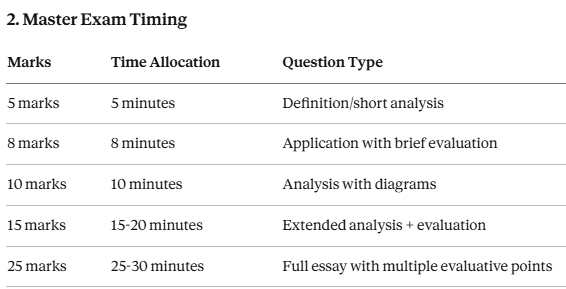
Practice tip: Use a timer for every past paper question. Speed improves with repetition.
3. Create a Diagram Bank
Sketch these diagrams from memory weekly:
AD/AS model (shifts and shocks)
Supply and demand (with elasticity variations)
Market structures (perfect competition, monopoly, oligopoly)
Externality diagrams (negative and positive)
Labour market equilibrium
Phillips curve
Laffer curve
Production possibility frontier
4. Build Your Real-World Example Database
Create flashcards or a spreadsheet with current examples for each theme:
Theme 1 examples:
UK plastic bag charge (5p → 10p)
London congestion charge
Sugar tax on soft drinks
Smoking ban in public places
Theme 2 examples:
Bank of England interest rate decisions
UK inflation rates (monthly updates)
COVID-19 fiscal stimulus (furlough scheme)
Brexit impact on trade balance
Theme 3 examples:
Amazon's market dominance
Tesla's pricing strategies
UK supermarket oligopoly
Trade union actions (rail strikes, NHS pay disputes)
Theme 4 examples:
China's development strategy
UK-EU post-Brexit trade agreement
IMF loans to developing economies
Global supply chain disruptions
5. Study Examiner Reports
Download reports from Edexcel for the past 3 years. Note:
Common mistakes students make
Phrases that earned high marks
Specific evaluation points examiners praised
6. Practice Synoptic Thinking
For Paper 3 preparation:
Take any micro topic and link it to macro consequences
Consider government policies from multiple angles
Connect different themes in your revision notes
Example: Minimum wage (Theme 3) → increased business costs → reduced international competitiveness (Theme 4) → potential impact on employment and inflation (Theme 2)
❌ Memorising essays – Examiners spot pre-learned responses instantly
❌ Ignoring data extracts – Missing application marks costs 20+ marks per paper
❌ Weak evaluation – "There are pros and cons" won't reach top grades
❌ Diagram-free answers – Especially costly in Theme 1 and Theme 3
❌ Outdated examples – Using 2019 data in 2025 shows poor preparation
❌ Ignoring command words – "Assess" requires more evaluation than "Explain"
3-6 months before exams:
Complete specification checklist coverage
Build comprehensive revision notes for all four themes
Create diagram and example banks
Review your school's predicted grades to identify weak areas
6-8 weeks before exams:
Complete 10+ full past papers under timed conditions
Review examiner reports and mark schemes
Update real-world examples with latest data
Practice drawing all diagrams from memory
Final 2 weeks:
Focus on Paper 3 synoptic practice
Memorize key statistics (inflation, unemployment, interest rates, GDP growth)
Review your most common mistakes from marked papers
Get adequate sleep—tired brains can't evaluate effectively
Q: How much should I write for a 25-mark essay?
A: Aim for 3-4 well-developed KAAE paragraphs plus introduction and conclusion—typically 1.5-2 pages of handwriting.
Q: Do I need to memorize exact statistics?
A: Approximate figures are acceptable ("around 4%" vs "4.2%"), but more precision demonstrates stronger preparation.
Q: How important are diagrams really?
A: Essential. Many mark schemes award specific marks for "accurate, well-labeled diagram with explanation."
Q: Can I use the same evaluation points in different essays?
A: Yes, but adapt them to the specific question. Generic evaluation scores poorly.
Q: What if I can't remember a real-world example?
A: Hypothetical examples can work if well-developed, but real examples score better for application marks.
The Edexcel A-Level Economics A specification is comprehensive but entirely manageable with strategic preparation. Success requires more than memorization—you must think like an economist:
Question assumptions
Consider unintended consequences
Weigh trade-offs objectively
Support claims with evidence
Acknowledge uncertainty and complexity
Master the four Assessment Objectives, practice extensively with past papers, and stay updated on current economic events. The combination of theoretical knowledge and real-world application is what transforms good students into A* achievers.
Remember: Economics isn't about having all the answers...it's about asking the right questions and building logical, evidence-based arguments. Master this skill, and you'll excel not just in exams, but in understanding the economic world around you.
Official Edexcel Specification: [Download from Pearson website]
Past Papers: Available on Edexcel website. Also included in our Revision Tracker. Download Here
Examiner Reports: Essential reading for understanding marking standards
Recommended Reading:
"The Undercover Economist" by Tim Harford
"Freakonomics" by Levitt & Dubner
The Economist magazine (free student access at many schools)
BBC News Economics section
Bank of England reports and speeches

Bubli -A Level Economics Tutor
I help my students stress less, score more, and enjoy Economics with real-life examples that click instantly.
Follow for more content updates
Free: The Revision Tracker 1000+ Students Are Using Right Now🡻
👉 including full-topic notes, model essays, essay structure, definition list, formula list, active recall quizzes, Essay Markings, and exclusive A* resources updated every week.
Click the button below to explore more and unlock the tools top students use to get ahead.

Bubli- A Level Economics Tutor
EXAM READY ECONOMICS
address: Kingfisher House, B3 Kingsway N, Gateshead NE11 0JQ
© 2025 ExamReadyEconomics